
UI/UX & Digital Experience
Interface, flow and product experience, from research to design system.
A brand is more than a logo. We design the identity, the rules and every asset that carries it, so you look like one company everywhere.
Brand identity design creates the visual system that makes a company easy to know on sight. It sets the mark, color, type, imagery and the rules for using them. Creative design then puts that system to work on real things: brochures, social posts, slides, packs, labels and merchandise.
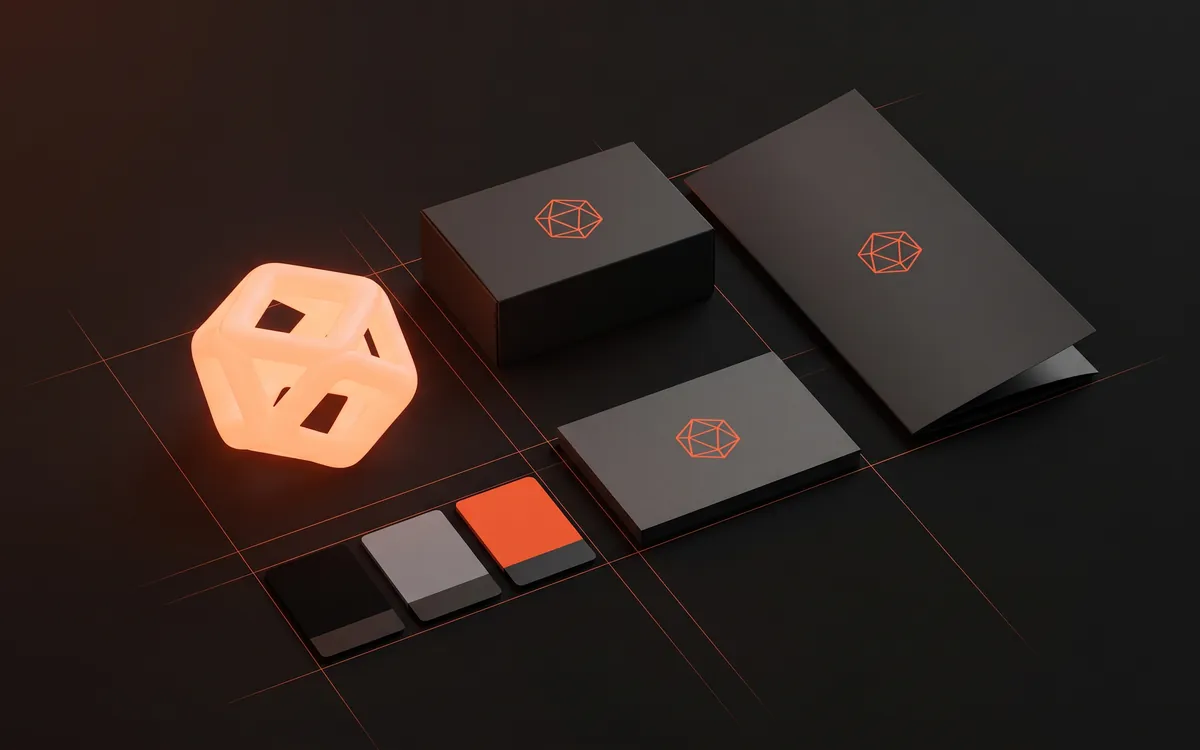
The system itself: the mark, the language around it, and the rules that protect it.
The mark, built as a system that works at every size and in every medium.
Color, type, imagery and visual language, defined as a coherent whole.
What the brand says and how it says it, defined alongside how it looks.
The document that keeps the identity intact once other people apply it.
The everyday applications: cards, letterheads, signatures and social kits.
The identity applied to campaigns, documents and screens.
Brochures, catalogs and print material prepared for real production.
Campaign, advertising and social assets built from the brand system.
Decks that carry an argument, in templates your team can keep using.
Turning real data and processes into something a reader can follow.
The brand on the product, the shelf and the object itself.
Structural and surface design for the container the product ships in.
Label systems that stay consistent across a whole product range.
The brand applied to objects people keep and to the space they buy in.
A good fit for
We learn what you do, who buys, how you are seen, and how competitors look.
We agree positioning, personality and a written brief before any visual work begins.
We develop mark, color, type and imagery together, tested at real sizes and in real media.
Guidelines record correct use, misuse and reasoning, with assets in every format your team needs.
We apply the system to the outputs in scope and prepare files to real production specs.
| Service | Usual situation | What it delivers |
|---|---|---|
| Logo design and redesign | No mark, or one that fails small or in print. | A mark with variants, usage rules and vector files. |
| Brand identity systems | Color, type and imagery are undecided or inconsistent. | A visual system for screen and print, tested in use. |
| Brand guidelines | Staff, printers or agencies apply the brand wrongly. | A usable guidelines document, misuse examples and asset library. |
| Digital and social creative | Campaigns and social posts look different each time. | Campaign sets, ad formats, social templates and banners. |
| Packaging, labels and merchandise | The brand must appear on a product or shelf. | Packaging, labels and merchandise artwork, ready for production. |
No. A logo is one component of a brand identity. The identity is the whole system around it: a color palette with defined roles, a typography system, imagery and art direction, logo variants for different sizes and backgrounds, usage rules, and the asset files your team and your printers need.
If more than one person will ever create something branded — an employee, a printer, an agency, a freelancer — then yes. Guidelines do not need to be long. They need to state the rules clearly enough that someone who was not in the design process can apply the identity correctly.
Yes. Packaging and label artwork is prepared to production specification: correct dielines, bleed, safe areas, color handling and file format. We work from your printer or manufacturer specifications, because packaging designed without them is artwork that has to be redone.
A refresh keeps existing recognition and fixes execution — inconsistent color, weak typography, a mark that fails at small sizes. A rebrand is worth it when the identity actively misrepresents what the business now does or who it sells to. Discarding recognition you already hold is a real cost, so we say which we think applies.
The brand identity defines the visual language; the interface design applies it to screens, states and components. They are different disciplines with different constraints — a color pairing that works on a printed brochure may fail contrast requirements on screen — so we design them to agree rather than assuming they will.
Vector source files for the mark, the full palette in screen and print color spaces, licensed or open font references, and export-ready assets for the applications in scope. Everything is organized so your team can find the right file without asking which version is current.
Short answers are above. Open a panel below for the specifics: how we decide, what is included and the deeper questions.
A new business, a changed business, or materials that no longer look like one organization. Every other service in this category applies the identity, so it comes first.
Where color, type and imagery are coherent and only the mark fails — at small size, in one color, in print — the smaller job is the correct one.
With a documented identity in place, brochures, campaigns, decks and packs are applications of rules already set, and they are faster and cheaper to produce.
A brand identity makes a company recognizable. It does not make a website or product usable, and where people cannot find things or finish tasks, the fix is interface design.
Brand messaging is what a company says about itself and how it says it: positioning statement, messaging hierarchy, key messages per audience, tone of voice and taglines. It relates to the visual identity as the verbal half of one system. A brand that looks consistent and describes itself differently everywhere is still inconsistent.
A messaging hierarchy puts the claims in order: the single idea the business wants to own, the handful of supporting points that prove it, and the detail beneath each one. Writers, sales teams and agencies then work from one source rather than inventing a description every time they need one.
Tone of voice is specified the way a visual language is: with principles, examples of what it sounds like, and examples of what it never sounds like. Taglines are developed from the positioning rather than as standalone slogans, because a line that cannot be traced back to a position cannot be defended when someone wants to change it.
Brand guidelines should include logo usage and misuse, color values for screen and print, typography with hierarchy and licensing, spacing and layout rules, imagery and iconography direction, tone of voice, and worked examples on real applications. They exist so someone who was not in the design process can apply the brand correctly.
Length is not the measure. A guidelines document that runs to a hundred pages and is never opened protects nothing, while a short document with clear rules, real examples and the right files linked from it gets used. The test is whether a printer, a new employee or an outside agency can produce something correct from it without a call.
Misuse examples are the most useful pages in most guidelines, because they show the mistakes people actually make: a stretched logo, a brand color on a clashing background, a substitute font, a mark placed on a busy photograph with no clear space.
Most businesses need business cards, a letterhead and document template, an email signature and a social media brand kit. These are the applications used every day by people who are not designers, so they have to be correct by default and simple to use without breaking the brand.
The priority has shifted toward digital. Email signatures and social profiles are seen far more often than printed letterheads, and they break in more ways: signatures that render differently across email clients, profile images cropped into circles that cut the mark off. They are designed for those conditions rather than adapted from print.
Social media brand kits cover profile images, cover images and post templates sized for each platform, so the business looks like itself across every profile. Printed stationery is still prepared as print-ready artwork where it is needed, specified for the stock and process your printer uses.
Marketing collateral is the material a business uses to communicate and sell: brochures, catalogs, flyers, posters and similar documents. It is print-ready when it matches the printer specification — correct size and bleed, safe margins, colors defined for the print process, images at production resolution and fonts handled as the printer requires.
Collateral usually fails on the second half of that definition rather than the first. A design approved on screen with no bleed, text too close to the trim, low-resolution images and colors defined only for a display will print, and it will print wrong. Preparing files to specification is part of the design work, not a separate step somebody else is assumed to handle.
A catalog is its own discipline, because it is a system as much as a document: product pages that repeat hundreds of times, a grid that holds variable content, and a structure that has to survive the updates of the following year without being redesigned.
No. We design collateral and prepare print-ready files to your printer specification, and we can review proofs before the run. Printing is carried out by your chosen printer, which keeps the artwork built for the process and stock you are actually paying for.
Digital and social creative design is the production of campaign and communication assets from the brand system: social posts and stories, digital advertisements, campaign sets, banners, website graphics, email marketing creative and event creative. Each format has its own dimensions and safe areas, and every asset has to carry one clear message.
Advertising creative has a harder job than most design, because it competes for attention it has not earned. The design requirements follow from that: a hierarchy that reads in a second, one message rather than three, a specific call to action, brand recognition without relying on the logo alone, and versions built for each placement rather than one image cropped to fit.
The efficient approach is a campaign system rather than a pile of individual files. A key design is established, rules are set for how it adapts across formats, and the full set is produced from it, which keeps a campaign coherent across every channel. We do not quote engagement or advertising performance figures; the only relevant numbers are the ones your own platforms report.
A good presentation carries one argument in a clear sequence, with one idea per slide, visual hierarchy that shows what matters, and data shown as a finding rather than a spreadsheet. A good pitch deck does the same for a funding or sales decision. Design serves the argument; it cannot replace one.
Most weak decks are writing problems presented as design problems. The first job is therefore structure — what the audience needs to believe, in what order, and what evidence supports each step — and only then layout, typography and charts. Visual storytelling is that sequence made visible.
Data slides get particular attention, because a chart should state its conclusion in its title and show only the data that supports it. Every figure in a deck we design comes from you and is shown as supplied; we do not create investor claims, market sizes or projections. The deliverable usually includes a reusable template system, so the next deck starts from the brand rather than a blank file.
An infographic is worth making when there is real data or a real process that people need to understand quickly and would not read as a report. It condenses information into a visual sequence. It is not worth making without real information, because an infographic built on invented or unsourced figures misleads.
The design questions are about honesty as much as appearance. Scales start where they should, proportions match the numbers, comparisons compare like with like, and every figure carries its source. An infographic that looks authoritative and distorts its data does more damage than having none.
Process diagrams follow the same rule. They are built from how a process genuinely works, drawn so that the sequence is readable with the visual stripped away, and labeled in the words the audience uses.
Product label design applies the brand to labels on bottles, jars, tubs and containers, usually across a range. It covers the label system — what stays fixed, what varies by product — the placement of required information, and artwork prepared to the label printer specification, including shape, material and finish.
Labels are small, curved, often wet or refrigerated, and read at a glance, so legibility decisions carry more weight than on almost any other surface. The label shape and the material — paper, film, clear or metallic — change how color reproduces and whether a white underprint is needed, so those are specified before artwork is final.
Stickers are designed and specified the same way, with cut paths prepared for die-cut or kiss-cut shapes. Full packaging structures, as opposed to labels on stock containers, are covered in detail on the packaging design page.
Merchandise design covers apparel such as T-shirts, drinkware such as mugs, corporate gifts and other branded objects, with artwork prepared for each decoration method. Retail branding applies the identity to the physical space where people buy: signage, displays, shelf material and point-of-sale graphics. We design and prepare artwork; suppliers produce the items.
Each decoration method has limits that the artwork has to respect. Screen printing is priced and limited by the number of colors, embroidery cannot hold fine detail or small text, engraving is one tone, and full-color printing on curved surfaces distorts near the edges. Artwork is prepared for the method your supplier uses, which is why merchandise frequently needs its own logo treatments.
Corporate gifts and merchandise are also where brands most often look cheap, because the item was chosen first and the logo added last. Choosing restraint — a single-color mark, placed with care, on an object worth keeping — usually does more for a brand than a full-color logo on everything.
A brand identity is designed once and applied many times, by many people, on surfaces with very different constraints. Consistency comes from every application drawing on the same system rather than on the last thing somebody made.
Mark, color, typography, imagery, layout and the guidelines that govern them. Everything below is an application of this system.
The identity translated into an interface, where text contrast, touch targets and responsive behavior add constraints print never faces.
Posts, stories, campaign sets and advertisement formats, each with its own dimensions and safe areas.
Business cards, letterheads, email signatures and the everyday templates people use without a designer.
Pitch decks, sales and corporate presentations built on a reusable template system.
Brochures, catalogs, flyers, posters and event material prepared for the printing process in use.
Boxes, cartons, bottles, jars, labels and inserts built on supplier dielines and print specifications.
Apparel, drinkware, corporate gifts and retail spaces, with artwork prepared for each decoration method.
Tell us what you need and when you need it. We reply with a clear scope and the next steps.